So, you may remember about 11 months ago that I got to shadow a current volunteer in Ghanzi while I was in training. Well last week I got to host my own shadow at my site, and it was lots of fun (and cool to be able to be on the other side). The only bummer is I completely forgot to take pictures! Whoops.
I met Kristin, my shadowee, in Moleps where I buy groceries. One so we could buy groceries, but also so she didn't have to hitch into my village by herself- that's a little scary when you are traveling in country the first time, and 'climb in a pick-up next to the hitching tree' isn't the most specific of instructions. Moleps wound up being a bit of a shadow party, as we bumped into about 6-7 other volunteers and their shadows at the KFC (rule #1 of shadowing: feed your trainee well. Who knows exactly what they get fed at homestay). We got groceries and squished into combis and got on our way. I was a little afraid I'd freak Kristin out with how far in the bush my site is, but she handled everything really well.
PC, for all of their flukes and quasi-illogical policies/communication, seems to be pretty spot-on with matching volunteers for shadowing. Kristin and I talked a ton, cooked good food, and basically had a fun 4 days in my village. She got to see me teach a class, plan a little bit at school, sort pills at the clinic, and interact with an out of school youth I'm helping with a business plan. She also got to play with kids in my yard and see how to deal with not having water for 3 days, including me having to get someone at my school to fill up my containers there and give me a ride home (I can do many things, but I can't walk home from school carrying 40L of water). Then I discovered the reason why my water was off was because the kids in my yard had turned off the valve to my house in the yard. I almost killed a kid. I mean, I started laughing when I figured it out, but SO SO SO frustrating. Le sigh. Kristin rolled with it though. And I immediately filled all of my containers again and we rejoiced at having water :)
It was a lot of fun having a shadow. She was a rockstar and hitched out of my village by herself after I dropped her at the hitching post, cuz I had to go back to school to teach. Having someone to talk to is lots of fun, and she was eager to learn about what its like to be a volunteer, and I was eager to share all the stuff I learned over the past year. A really fun week, hopefully I get an awesome shadow next year too :)

The adventures and day-to-day life of a Hokie that enjoys traveling, nature, people, and public health.
Monday, September 16, 2013

Teaching
I think I left off my last blog entry that I was going to attempt to interact with more students by hanging out after school and trying to play games with them. This is a good idea in theory (like so many other things I've tried), but the reality is I still don't know many kids really well, so they are reluctant to come over and attempt to play a game/talk with me.
So, I've sort of broken a Peace Corps rule* and started teaching guidance and counseling classes. My main counterpart is still out sick frequently, which means that most of these classes haven't had a G/C teacher for months. My substitute counterpart is nice and trying to run the committee in the interim, but she is also a full time moral education teacher, so she can't pick up an extra 18 classes a week. So I've stepped in.
Right now, I've taken on the six classes of Form 2 students. The level of English at my school overall is very low, so probably half the kids can't understand me (and I have a funny American accent). When I've tried to talk to the Form 1s, I get blank stares and a few brave kids telling me they don't understand. The Form 3 students are taking their big end of school test in a month, and they've either mentally checked out or are actually studying. So I'm teaching Form 2s, hoping to build relationships with them that can continue on into next year when they become Form 3s. Maybe next year I'll add on Form 2s (the current Form 1s, the school year here is January-November) as well.
So far it's been fun and challenging. I've had the kids made little name cards like they were at a conference so I can learn some names. I try to get them to interact a bit instead of just talking at them- it sort of works. There's still a big language barrier, so the challenge is to not dumb down the lesson content, but to have as many of them understand me as possible. So far I've been getting help from other teachers to translate key phrases of my lessons into Setswana, so I can speak in English, and then have flipcharts (poster paper) with key phrases in English and Setswana, and then read the Setswana to them. Verbal and visual in two languages. It's a lot of work, but I give the same lesson six times, so it's not bad to do one per week. Also, I'm getting some teacher's attention as I make these visual aides and ask for Setswana help, and I've had two ask me to help them teach more creatively- WIN! This is something I've been trying to do since I got here.
Teachers in this country are taught to basically write notes on the blackboard, students copy them, and memorize the content. This gets information across, but it does nothing for skill building and critical thinking. As far as HIV is concerned, this population is over-saturated with HIV messaging. Although, especially working with youth, you find plenty of people with incorrect facts and misconceptions. But even more than getting the facts right, PCVs are trying to build skill sets. How to make good decisions and think the process over, including different outcomes, consequences, and looking to the future. How to manage stress in healthy ways. How to negotiate condom use. I'm pretty sure my students have been talked to about stress and what it is and that being healthy helps manage it. But what does that actually mean? I'm trying to have them focus first on knowing themselves, so they know what makes them happy. Different people will relieve stress in different ways- healthily. Some people want to read, some want to play soccer, some want to talk with friends. You need to know what destresses you, and that its okay that you de-stress differently from your friends. You need to be able to think critically and realize that drinking might relieve your stress now, but it will cause more problems down the road. With condoms, people know they should use them. But a lot of the time they don't. When I get to that subject, I'll make my kids do dramas (skits) about talking with their partners. At camps we do condom demonstrations. All this to say, we are trying to be as interactive as possible, as life skills volunteers working with youth. We are life skills, not life information, volunteers.
So teaching is fun. I like preparing the lesson plans. I'm getting to know teachers and students better through the process. The teaching itself is a little scary each time I walk in a classroom, but usually after a minute or two I'm fine. I enjoy talking with the students, and I try to treat them like adults. That's another thing I emphasize: these students are 15-19. Botswana considers you a youth often until you are 35, but these guys really are adults or close to it. If I treat them like adults, I can emphasize that these are adult decisions and lifestyle choices they are making. Often it's a new idea for them.
So that's my main project for now. Still working on showing STEPS films, working with out of school youth, and getting functional clubs. But it's nice that I can make something work mostly by myself, and I know it won't be randomly canceled every single time I do it :P I'm also trying to plan another camp, so more on that in a future post when I get things nailed down.
*Peace Corps discourages teaching, especially in the beginning of our service, mostly so the school doesn't get the wrong idea and thing we are just another teacher. Now that I've been at my site for almost 9 months, I'm less worried about that, and I think this is probably the best way to do lifeskills at my school currently.
So, I've sort of broken a Peace Corps rule* and started teaching guidance and counseling classes. My main counterpart is still out sick frequently, which means that most of these classes haven't had a G/C teacher for months. My substitute counterpart is nice and trying to run the committee in the interim, but she is also a full time moral education teacher, so she can't pick up an extra 18 classes a week. So I've stepped in.
Right now, I've taken on the six classes of Form 2 students. The level of English at my school overall is very low, so probably half the kids can't understand me (and I have a funny American accent). When I've tried to talk to the Form 1s, I get blank stares and a few brave kids telling me they don't understand. The Form 3 students are taking their big end of school test in a month, and they've either mentally checked out or are actually studying. So I'm teaching Form 2s, hoping to build relationships with them that can continue on into next year when they become Form 3s. Maybe next year I'll add on Form 2s (the current Form 1s, the school year here is January-November) as well.
So far it's been fun and challenging. I've had the kids made little name cards like they were at a conference so I can learn some names. I try to get them to interact a bit instead of just talking at them- it sort of works. There's still a big language barrier, so the challenge is to not dumb down the lesson content, but to have as many of them understand me as possible. So far I've been getting help from other teachers to translate key phrases of my lessons into Setswana, so I can speak in English, and then have flipcharts (poster paper) with key phrases in English and Setswana, and then read the Setswana to them. Verbal and visual in two languages. It's a lot of work, but I give the same lesson six times, so it's not bad to do one per week. Also, I'm getting some teacher's attention as I make these visual aides and ask for Setswana help, and I've had two ask me to help them teach more creatively- WIN! This is something I've been trying to do since I got here.
Teachers in this country are taught to basically write notes on the blackboard, students copy them, and memorize the content. This gets information across, but it does nothing for skill building and critical thinking. As far as HIV is concerned, this population is over-saturated with HIV messaging. Although, especially working with youth, you find plenty of people with incorrect facts and misconceptions. But even more than getting the facts right, PCVs are trying to build skill sets. How to make good decisions and think the process over, including different outcomes, consequences, and looking to the future. How to manage stress in healthy ways. How to negotiate condom use. I'm pretty sure my students have been talked to about stress and what it is and that being healthy helps manage it. But what does that actually mean? I'm trying to have them focus first on knowing themselves, so they know what makes them happy. Different people will relieve stress in different ways- healthily. Some people want to read, some want to play soccer, some want to talk with friends. You need to know what destresses you, and that its okay that you de-stress differently from your friends. You need to be able to think critically and realize that drinking might relieve your stress now, but it will cause more problems down the road. With condoms, people know they should use them. But a lot of the time they don't. When I get to that subject, I'll make my kids do dramas (skits) about talking with their partners. At camps we do condom demonstrations. All this to say, we are trying to be as interactive as possible, as life skills volunteers working with youth. We are life skills, not life information, volunteers.
So teaching is fun. I like preparing the lesson plans. I'm getting to know teachers and students better through the process. The teaching itself is a little scary each time I walk in a classroom, but usually after a minute or two I'm fine. I enjoy talking with the students, and I try to treat them like adults. That's another thing I emphasize: these students are 15-19. Botswana considers you a youth often until you are 35, but these guys really are adults or close to it. If I treat them like adults, I can emphasize that these are adult decisions and lifestyle choices they are making. Often it's a new idea for them.
So that's my main project for now. Still working on showing STEPS films, working with out of school youth, and getting functional clubs. But it's nice that I can make something work mostly by myself, and I know it won't be randomly canceled every single time I do it :P I'm also trying to plan another camp, so more on that in a future post when I get things nailed down.
*Peace Corps discourages teaching, especially in the beginning of our service, mostly so the school doesn't get the wrong idea and thing we are just another teacher. Now that I've been at my site for almost 9 months, I'm less worried about that, and I think this is probably the best way to do lifeskills at my school currently.
Wednesday, September 4, 2013
10 years
It will be ten years tomorrow since I lost my dad. Ten years
is a long time. It’s a third of my life. A lot has happened in ten years. The
last time I saw my dad, I had finished two years of college and just dropped
out for a semester because we realized how sick he was. Since then I finished my chemistry degree,
worked for a small pharmaceutical company, worked for the chemistry department
at Virginia Tech, and then decided to switch careers. I got a masters in global
public health, and spent a summer doing research in Ghana. I moved from
Maryland to Blacksburg to Atlanta to Africa. Now I’m serving as a Peace Corps
volunteer in Botswana. Sometimes I feel like dad may think I’ve lost my mind,
if he could see where I am today. It’s not that I’m doing anything bad, but it’s
so far from the course he helped me set at age 18, or maybe 15.
It scares me sometimes that my life seems so normal without
my dad. What they say about a ‘new normal’ after someone dies is completely
true. Normal now is just me and my mom. We spend holidays together (when I’m
not in the Peace Corps), vacation together, help each other move, talk on the
phone weekly. Memories of a Christmas where it was the three of us are so far
removed that it feels like the memories belong to someone else.
And yet the memories are there, in every part of my life.
Dad teaching me to do laundry when I was twelve. Dad taking me hiking in North
Carolina when I was six. Dad chaperoning girl scout trips, when he got all of
us to chorus BEEP BEEP BEEP as he backed up the old red van, causing my girl
scout leader to laugh so hard so could barely see the road. Taking me canoeing
with his boy scout troop when I was five and plucking me out of the water when
I fell in. Helping me with math homework, teaching me how to budget my allowance.
Tolerating my hamsters and guinea pig, and even voluntarily picking up cinnamon
(the guinea pig) every now and then. Supporting me in school, sports, drama, my
faith. Pushing me to give things my best effort. Taking the time to talk with
me about things (sometimes more than I wanted). Swimming in the ocean with me.
Cooking creatively in the kitchen, to the point that I demanded to know exactly
–what- went in that omelet before I would eat it. Taking me on visits to colleges.
Volunteering with my church youth group hours and hours a week. Mentoring boy
scouts. Loving and respecting my mom. Being a peacemaker in our family when
things got heated. Telling everyone to be alert… because the world needs more
lerts. Teaching me by example how to sleep for 14 hours straight and then being
WAY hyper on family vacations. Frying 6 turkeys one thanksgiving to get the
most use out of the oil. Opening his Christmas presents one year lying on his
back, kicking his feet in the air, pretending to be 5 (while mom was afraid he’d
drop the dutch oven he was unwrapping on his face). Always logical, always
caring, always a sense of humor.
I see so much of him in myself, and I like that. I inherited
his and mom’s heart for service and youth, a big reason I’m where I am now,
serving as a PCV working with youth. I feel like I could have explained my
career change to him and he would have been supportive, I’m just sorry I never
got that chance.
He was also very much in favor of me taking risks and being
my own person, so I don’t think it would bother him that I’m hanging out in
Africa. I was showing signs of the international travel bug as a freshman in
college. I went to him with my plan (that didn’t materialize) of going to
Kazakhstan over my first spring break, and we strategized over how best to
break the idea to mom without freaking her out. (Keep in mind this was like, 2
months after 9/11).
I have no regrets about how I spent the time I had with my
dad. Sure, I was an emotional teenager at times, but we were able to talk
things out and nothing was really left unsaid. I’m only sorry that the
beginning of our friendship as two adults got cut so short.
I found the following shortly after dad died and I always identified
with it. I was 20 when he passed, and the cars full of teenagers would often be
going to and from scouting activities and youth group.
A great man died today.
He wasn't a world leader or a
famous doctor or a war hero or a sports figure. He was no business tycoon, and
you will never see his name in the financial pages. But he was one of the
greatest men who ever lived. He was my father.
I guess you might say he was a
person who was never interested in getting credit or receiving honors. He did
corny things like pay bills on time, go to church on Sunday and serve as an
officer in the P.T.A.
He helped his kids with their
homework and drove his wife to do the grocery shopping on Thursday nights. He
got a great kick out of hauling his teenagers and their friends to and from
football games.
Tonight is my first night
without him. I don't know what to do with myself. I am sorry now for the times I
didn't show him the proper respect. But I am grateful for a lot of other
things.
I am thankful that God let me
have my father for 15 years. And I am happy that I was able to let him know how
much I loved him. That wonderful man died with a smile on his face and
fulfillment in his heart. He knew that he was a great success as a husband and
a father, a brother, a son, and a friend.
I wonder how many millionaires
can say that.
Sunday, August 18, 2013
Vacation Part 6: Capetown
Capetown is beautiful, even in winter. We attempted to hike Table Mountain, went out to Cape of Good Hope nature reserve and Cape Point, we saw penguins and Ostriches, we went to Stellenbosch Gardens, the Gold Museum, the Slave Post museum, and the waterfront. We attempted whale watching and Robbin Island but the weather didn't work out and the boats were canceled.

The gardens.


On the way to Cape of Good Hope are penguins...

Penguin!

Swimming

Taking a good look around.

Ostriches IN the road at the Cape of Good Hope. We were all, let's roll down the windows and take pictures!! Our cab driver thought we were nuts.

Steenbok!

We visited an ostrich farm and got to feed them. This one was a little bossy.

Cormorant drying his wings.

Yummy food everywhere.

The civic center had a neat exhibit on Nelson Mandela, since we were in Capetown right after his 95th birthday.

This is an art exhibit at the civic center. Using fence from Robbin Island, the artist represents the tiny cell than Nelson Mandela served something like 18 of his 27 years in prison.

As you can see, a cloudy day at the waterfront.
More pictures coming, I'll update this post later (forgot my memory stick with the rest of the pics).
Saturday, August 17, 2013
GLOW Camp!
Myself and 6 other volunteers from my region did a GLOW (girls and guys leading our world) camp for 32 kids for 5 days, July 29th - August 2nd in Khudumelapye, the village next to mine.

It required a lot of food, but the alcohol levy provided it for us.

We started camp with a bonfire and get to know you games.

Corey was not actually on fire, but was DJing from his laptop.

We talked about self-esteem and knowing yourself.

Since the theme was friendship, we talked about how animals can be our friends, especially dogs.

Which was funny since Snoopy, a dog from Aileen's compound,
decided she really wanted to come to camp.

We talked about gender roles, and the difference between gender and sex.

The kids made skits about refusing alcohol and dealing with peer pressure.

They thought about what it means to be a leader.

We tried to keep it fun and interactive- batting around blown up condoms to break the ice before talking about sex.

Puberty 101: Everything you've always wanted to know...

We kept a question box going the whole camp, and got really good questions.
Some very hard to answer.

Our PC Botswana country director Tim Hartman and Ambassador to Botswana Michelle Gavin came and talked with the kids.

We made collages about ourselves and our goals.

We made friendship bracelets.

We did a science experiment with volcanoes.

Corey taught the kids self defense at 6am!

We also did early morning games and yoga.

Lots of downtime for football,

jump rope, and whatever other games the kids wanted to play.

We slept in some classrooms, each school bundled together at night under a pile of blankets.

Sometimes naps were in order (or at least wanted).

At night we had fun things like the campfire, a movie night, a traditional dance performance, and a talent show.

My girls from Salajwe and their certificates for attending camp.

My guys from Salajwe.

Camp GLOW!
And for a few funny "out-takes"...

Sleeping donkeys by the water pumps. They want to come to school too! Also, some slept RIGHT outside of our classroom, so when I had to use the latrine at midnight, I scared them awake and they knocked over a bucket as they ran off, which scared the crap out of me and I thought was going to wake the whole camp. Oh life.
 \
\
We got to prepare breakfast, and heat water for bathes twice a day.

A rooster half the size of Finda wants some of the spilled rice.

We had to blow up the condoms for the condom balloon game...
Glow camp was great. Stressful at times because of the logistics, but I really hope I can do another one during my service.
Vacation Part 5: Victoria Falls
On July 18th we crossed into Zambia by boat. Where the Zambezi and Chobe rivers meet is where 4 African countries meet as well: Botswana, Namibia, Zambia and Zimbabwe. We got to 3/4 :)
We checked in at the JollyBoys Backpackers and headed to the falls on the Zambia side.

And this is at relatively low water!

The famous bridge over the gorge downstream of the falls. We crossed it going into Zim.

Mom and me.

Carol 'I'm never excited about anything' :D

Amazing.
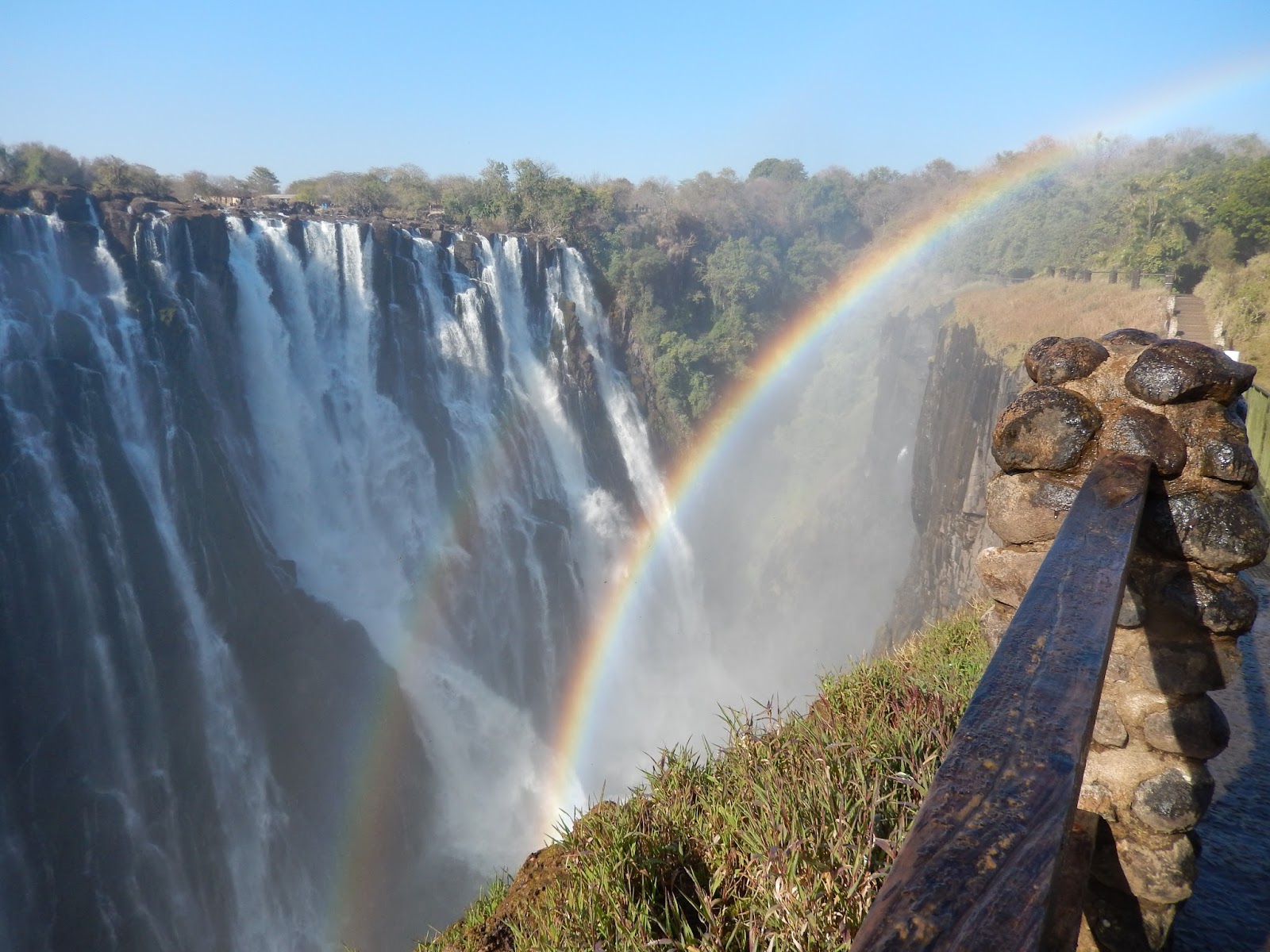
Appropriately named rainbow falls.

Mom at rainbow falls.

Our cute little room at the backpackers, with me under my personal mosquito net.

The next day we sprung for a helicopter ride over the falls. It was totally worth it, its the only way to see the whole thing at once because its so big!

During the rainy season its hard to actually SEE the falls because there is so much mist.

Definitely one of the natural wonders of the world.

After the helicopter we crossed into Zimbabwe for the day to see the falls from that side.
Mosi-ou-tunya: The smoke that thunders

Ate in a yummy restuarant on the Zim side- mom with her beautiful salad.

Random warthogs roaming around near the restaurant.

Zim side falls- I think this was the 'main falls'.

Magnificent.

Mom dressed appropriately for the occasion.
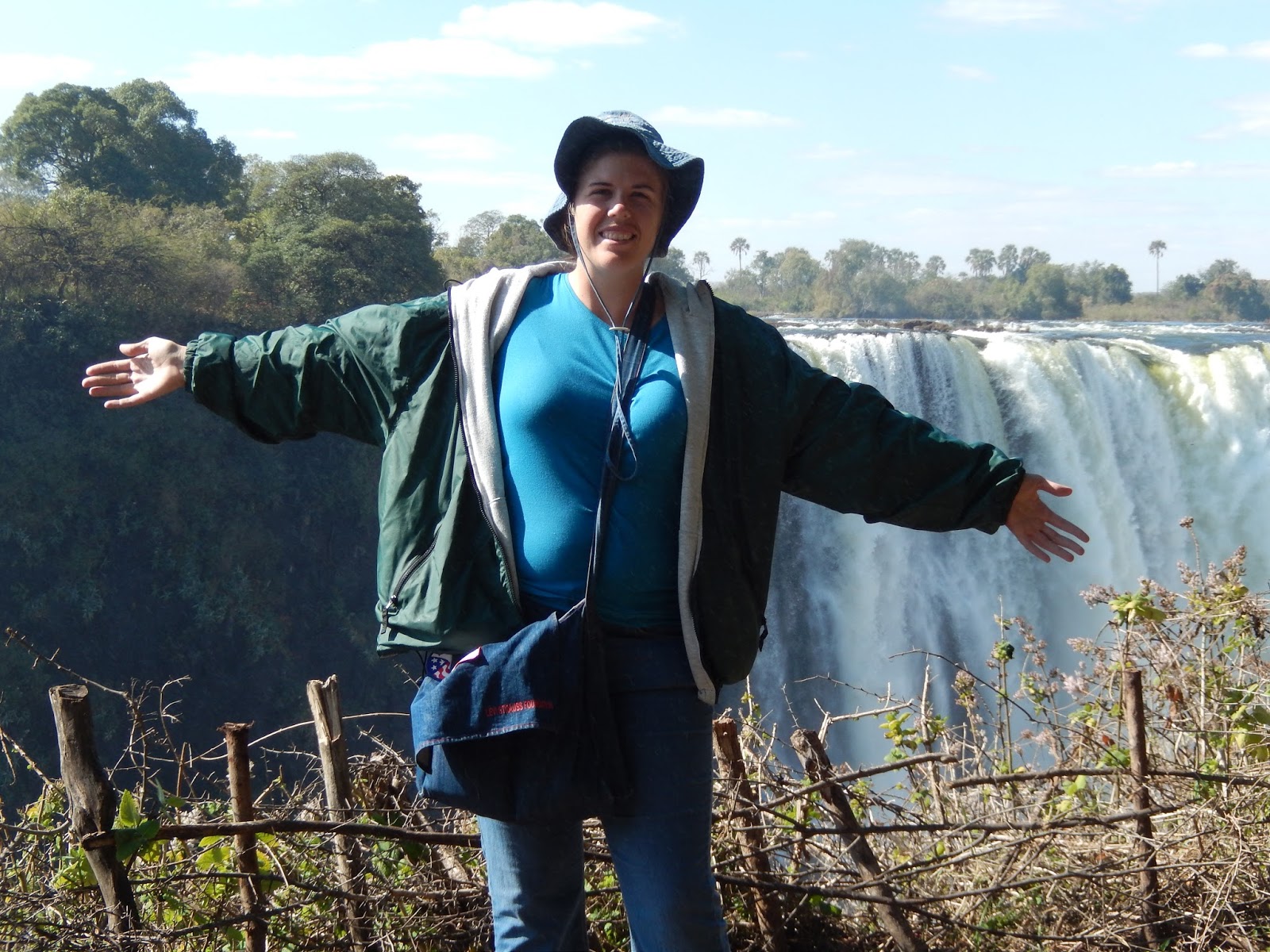
I'm at Vic Falls!

More rainbows on the Zim side too.
We crossed back into Zambia after watching some people bungee jump into the gorge (on the bridge above). Overall we roamed around Livingstone a bit, ate some Zambian food that was delicious, and enjoyed the backpackers. We crossed back into Botswana on the 20th, and went for the 3rd game drive in Kasane on the 21st (where we saw the leopard!) before flying to Capetown that afternoon.
Part 6 of the Vacation was Capetown, coming soon!
Subscribe to:
Posts (Atom)